
Design Wins: Wireless Innovation Across Hearing Aids, Logistics, and ADAS

From transformative hearing aids to advanced automotive vision systems, recent product announcements reflect how semiconductor and system-level innovations are driving real-world impact across sectors. The following three “design wins” demonstrate not only the technical prowess behind the components involved but also the importance of cross-industry collaboration in turning design into delivery.
Wireless Hearing Tech Enhances Quality of Life
In collaboration with hearing care leader Sonova, Semtech has delivered the ERA chip, an ultra-small, ultra-low-power 2.4-GHz radio and power management SoC that now powers Sonova’s latest hearing aids, including the Phonak Audéo R Infinio. This solution integrates Bluetooth and multiprotocol wireless connectivity with an advanced single-inductor multiple-output (SIMO) power management unit, all in a chip optimized for battery-operated healthcare devices.

Semtech says its ultra-low power 2.4-GHz wireless radio and power management IC offers significantly enhanced connectivity. Image used courtesy of Semtech
Sonova selected Semtech for its expertise in power-efficient wireless IC design. The result is a hearing aid platform with enhanced signal-to-noise ratio (up to +6 dB improvement), over 550 MOPS of DSP processing, and universal Bluetooth compatibility with 6,800+ devices. These features support advanced capabilities like hands-free calling, real-time audio streaming, and adaptive scene analysis using AI-assisted DSPs and neural network chips such as Deepsonic.
The collaboration directly addresses a global challenge: by 2050, over 2.5 billion people will have some degree of hearing loss, according to the WHO. Devices leveraging Semtech’s ERA chip feature a long battery life and compatibility with next-gen standards like Auracast. The chip also offers IoT integration via LoRa, positioning it for future-ready hearing care in both consumer and clinical environments.
Nordic-Powered Tracking for Sustainable Logistics
Advantech’s LEO-L50 outdoor asset tracker—winner of the 2025 Taiwan Excellence and iF Design Awards—is another standout example of embedded innovation. Designed for large asset tracking in global logistics, the device is powered by Nordic Semiconductor’s dual-core nRF5340 SoC, providing Bluetooth LE 5.4 connectivity and application-layer processing in a ruggedized IP67-rated package.
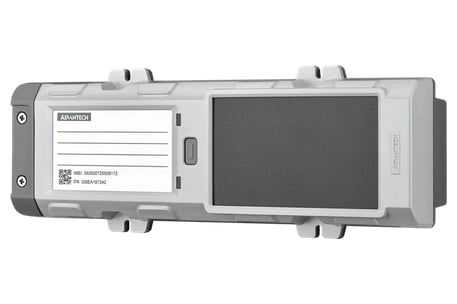
The Nordic nRF5340 SoC. Image used courtesy of Nordic Semiconductor
The nRF5340 features dual Arm Cortex-M33 cores and supports Zephyr RTOS for flexible development. It enables the LEO-L50 to supervise onboard sensors, like door and temperature sensors, and relay that data over Bluetooth LE or cellular to the cloud. A low-power design with a rechargeable Li-ion battery and solar charging extends operational life to seven years, a crucial spec for unpowered freight containers and field-deployed assets.
Beyond its technical merits, the LEO-L50 aligns with logistics decarbonization goals. It facilitates Scope 3 emissions monitoring and AI-based route optimization. Nordic’s developer resources, including the nRF Connect SDK and Development Kit, were critical to expediting Advantech’s design cycle.
Ceva NPU Powers Next-Gen Automotive Vision
In the ADAS space, Ceva’s NeuPro-M neural processing unit has been selected by Korean semiconductor company Nextchip for its next generation of edge-AI chips, specifically targeting smart vision applications in advanced driver-assistance systems (ADAS).
The NeuPro-M IP includes scalable MAC array configurations, on-chip memory, and tightly coupled vector DSPs, supporting up to 12 TOPS. Nextchip will embed it into its proprietary Apache5 SoC for real-time, low-latency inference on camera and sensor data, critical for features like lane departure warnings, object classification, and pedestrian detection.
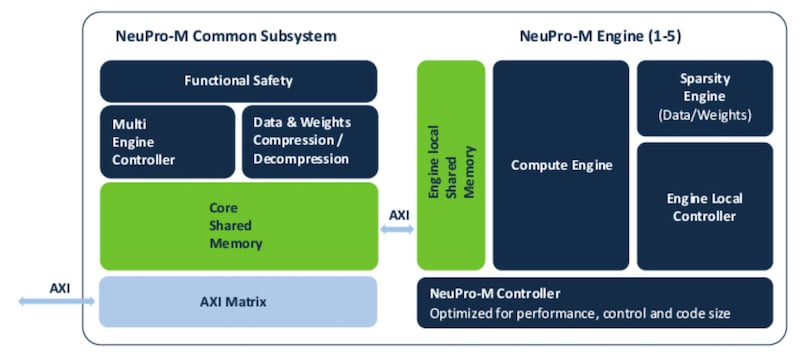
The Ceva-NeuPro-M NPU family. Image used courtesy of Ceva
Ceva’s AI SDK, NeuPro Studio, plays a key role in accelerating development cycles. The tools allow Nextchip to map neural networks efficiently, including convolutional and recurrent architectures, directly onto the NeuPro hardware. This minimizes power consumption while maximizing throughput, critical for thermally constrained automotive environments.
With vehicle autonomy trends advancing and regulation tightening around road safety, Ceva’s inclusion in a production-grade ADAS silicon platform represents more than a technical win; it’s a vote of confidence in the scalability and reliability of edge AI hardware in mission-critical environments.
link