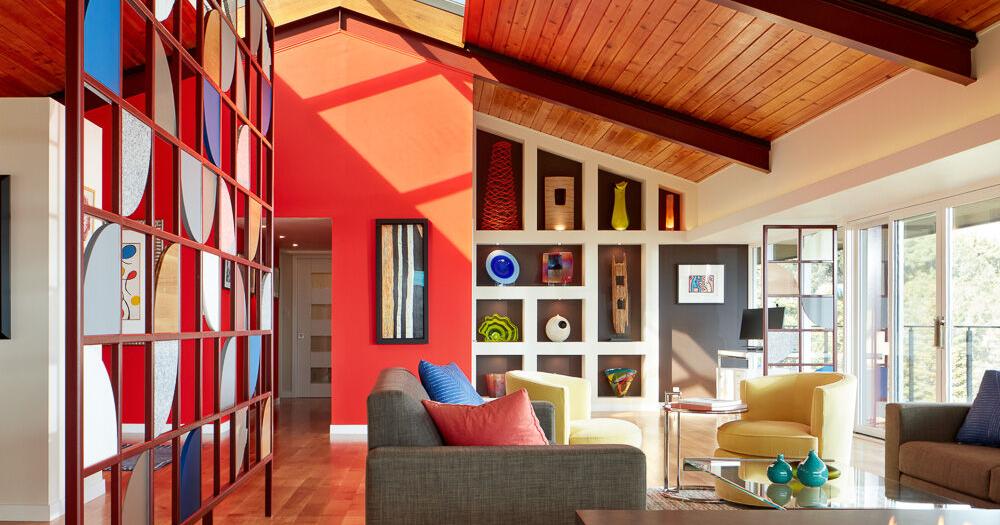
While trends have changed – from tile choices to the use, and non-use, of color – Lisa Sten, CEO of Mountain View-based Harrell Design + Build, said one thing has been constant for Harrell Design + Build: the business’s innovation.
Approximately 40 years ago, Iris Harrell founded Harrell Remodel, now known as Harrell Design + Build. The business provides home remodeling, among other similar services, to clients in Mountain View and surrounding communities.
Harrell didn’t initially pursue remodeling or building – prior to founding Harrell Design + Build, she was a teacher and musician. While a traveling solo artist in 1980s Texas, Harrell met her now-wife Ann Benson at one of the first all-lesbian “coffeehouses” at the Dallas National Organization for Women’s office.
“I showed up to sing and play some original songs with my guitar, Ann showed up to play and sing and brought down the house by singing a Hank Williams song and changing the pronouns and yodeling,” she said.
Harrell and Benson moved into a 1920s duplex together shortly after, which is where Harrell had her introduction to renovation.
“I was learning to fix up with the ‘Readers Digest: Fix-It-Yourself Manual,’” she said. “And I would hire guys who had experience in trade. I would get the jobs, and then I would work beside them and learn how to do whatever it was that I had sold to the clients. So, you know, I ran into resistance, but I don’t think that that exists anymore.”
The couple decided to move to Menlo Park in 1985 to feel safer, she said. After moving to the Bay Area, Harrell and Benson joined a women’s softball team to meet other women.
One of her teammates, Katy, was a painter, “who brought me to her jobs when there was dry rot or miscellaneous work to do, and I painted for her as well,” Harrell said. “Another player, Beth, was building custom doll houses in Atherton. I hired her as my first employee after I got my California contractor’s license.”
The rest was “her-story,” Harrell said. She was one of the first women in the remodeling and building industry, and she said she faced resistance in the early days of her renovation career.
Sten joined Harrell Design + Build in 2000; while there are more women in the construction sphere, Sten noted the construction industry continues to be predominantly male-led. “But there are more women owners, or, you know, a woman with her husband, or a woman with her brother, who are starting to run or are running companies,” she said.
At Harrell Design + Build, two of the three CEOs, Harrell and Sten, have been women. The second CEO, Ciro Giammona, was CEO from 2014 to 2020. He joined the team around the time Sten did, and he was one of the team members who helped pave the way to the Harrell Design + Build team becoming employee-owned.
A point of pride for Harrell and Sten, being employee-owned – meaning employees have financial stake in the company – allows for employees to feel like owners themselves, resulting in what Harrell and Sten believe is a better work ethic and client relationship.
The employee-owned model, which Harrell worked to establish in 2000 but went into effect when she and Benson retired in 2014, fit Harrell’s belief that if the employees feel like owners of the company, they’ll have more pride in their work and the business itself.
“In terms of capitalism, wrong capitalism is only for the wealthy,” she said. “The only problem with capitalism in this country is that we don’t have enough capitalists. And if we had more capitalists, we would be more productive as a country.”
Harrell said the longevity of the business was something she didn’t necessarily think about until she met her wife.
“My father was a farmer and a truck driver, my mother was a beautician, and we were from Virginia and North Carolina,” she said. “(We were) working-class people, we didn’t think about what’s going to happen next week. We don’t think about what’s happening 30 or 40 years from now.”
But Benson, whose family was upper-middle class, knew retirement was something to plan for, and they knew they themselves would have to not only prepare for themselves, but help their employees plan for their own retirements and futures.
“They’re supporting our business and their clients, which means we are benefiting from it,” Harrell said. “How do we figure out how to share that?”