
The Forgotten Designer Who Created America’s First National Parks Posters
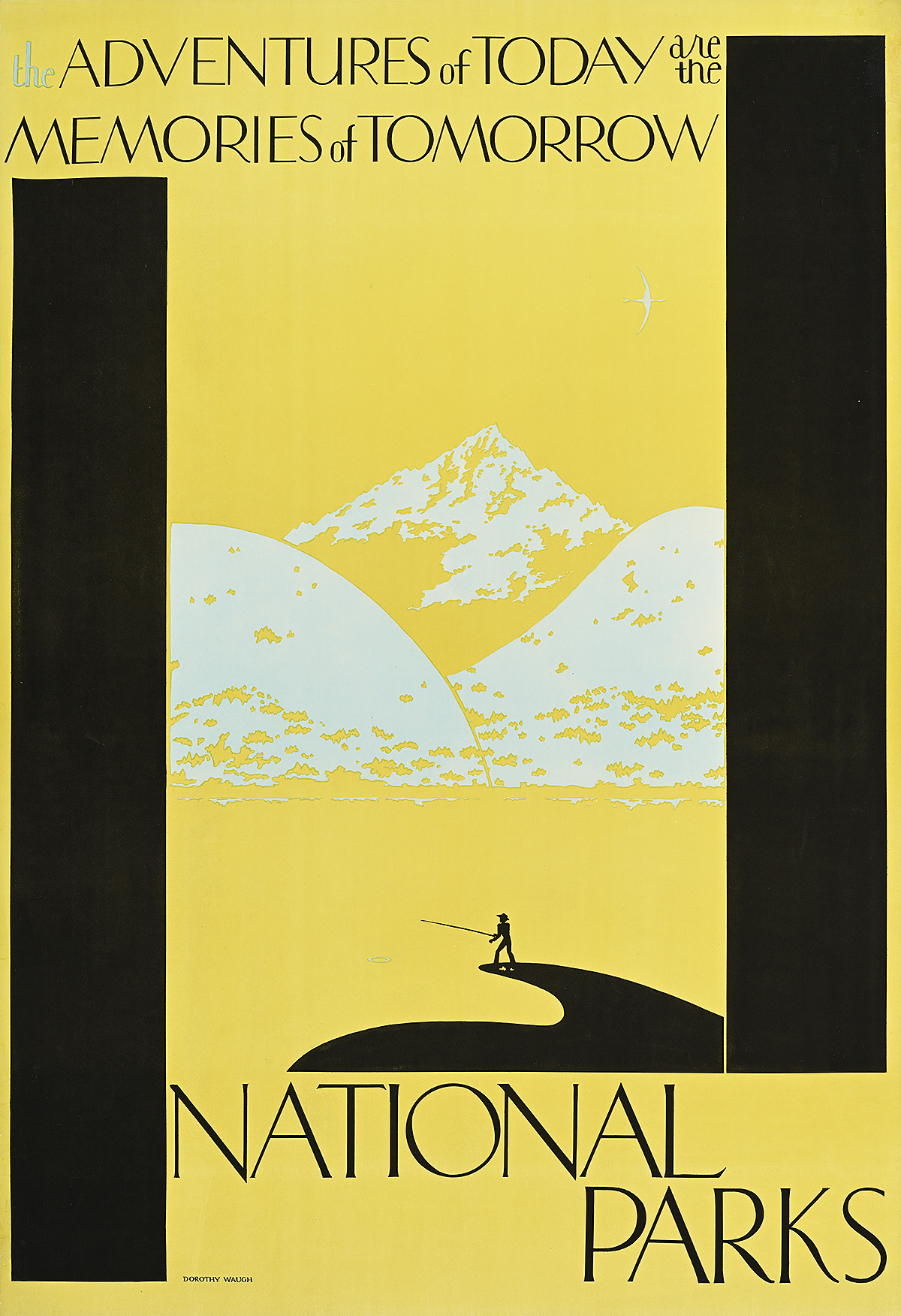
Dorothy Waugh, a pioneering Modernist designer who created the U.S. government’s first in-house National Parks poster campaign during the Great Depression, is the subject of her first-ever solo exhibition—a show 30 years in the making.
On view at New York’s Poster House, “Blazing a Trail: Dorothy Waugh’s National Parks Posters,” the show reunites all 17 posters Waugh designed for the National Park Service between 1934 and 1936—bold, experimental works that helped define a new visual language for federal design while breaking ground for women in a male-dominated field. Long overlooked despite a prolific, wide-ranging career, Waugh is now being reintroduced as a key figure in American Modernist graphic design and New Deal–era cultural history.
“The federal government had never sponsored their own in-house poster campaigns, full stop—let alone had a solo female Modernist designer do such a campaign in what was a very male-dominated bureaucracy,” arts consultant and guest curator of the exhibition Mark Resnick said during a tour of the exhibition.

Dorothy Waugh, ca. 1930. Courtesy of the Jones Library, Inc., Amherst, Massachusetts, via Poster House.
Resnick first spotted Waugh’s work in the window of a New York gallery that specialized in posters back in the 1990s. He was struck by its strong Modernist design, which bucked conventions, and shocked that he could find next to no information about the artist or her career.
“I set out to find her story,” he said.
It took a bit longer than expected—about three decades—but Resnick has now done just that, bringing Waugh out of the shadows after tracking down relevant documents and records across the National Archives, the Library of Congress, Waugh’s alma mater the School of the Art Institute of Chicago, the National Park Service, and the Jones Library in Amherst, Massachusetts, home to the Waugh family’s archives.

Dorothy Waugh, The Lure of the National Parks (1934). Private collection. Image courtesy of Poster House.
The Power of Good Design
President Franklin Delano Roosevelt thought that the National Parks were national treasures, and that they would help bolster Americans’ shattered morale during the depth of the Great Depression, Resnick explained. “If you could get people traveling throughout the country, spending into local economies, that was a big deal.”
As Roosevelt declared 1934 National Parks Year, Waugh pushed to mount a poster campaign for the occasion—and the poster subsequently became a crucial tool of the Works Progress Administration (WPA) and the U.S. government.

Dorothy Waugh, National Parks/Winter Sports (1935). Private collection. Courtesy of Poster House.
Waugh’s lithographs represented a new strategy for the NPS, founded in 1916, which had previously let the railroads do all their advertising, focusing on the trains that made travel to these destinations possible.
But Waugh’s posters pushed the form, not limiting herself to the straightforward depiction of scenic park landscapes that typically appeared in posters for the railroads. There are two examples of the latter, by Gustav W. Krollman and the other in the style of Thomas Moran, drawn from the Poster House collection for the show.

Dorothy, right, and her brother Sidney (ca. 1915). Courtesy of the Jones Library, Inc., Amherst, Massachusetts via Poster House.
Instead of representing individual parks, Waugh chose images that would speak more broadly to what the National Parks had to offer, such as wildlife or winter sports. Her work was distinctly optimistic; she used bold color palettes, graphic shapes that bordered on abstraction, and hand-drawn lettering with unique letterforms. It was an approach informed by European Modernism, but in the realm of commercial illustration, incorporating American iconography.
Tracking Down Waugh’s Work
Though the NPS printed thousands of each poster, Waugh’s designs were essentially ephemera, and many have not survived. Tracking down a copy of all 17 posters—mostly from a single anonymous collector—was a major challenge for Resnick. One design almost eluded him—until he mentioned his fruitless search for one of Waugh’s ski posters to a friend.

Dorothy Waugh, National and State Parks (1936). Collection of Cathy M. Kaplan. Courtesy of Poster House.
Resnick recalled telling a friend about the show when she replied, “I ski and have a country house in Upstate New York—I think I know the poster you mean.”
The friend had previously purchased it at auction, where the artist was unknown. The poster was the missing piece in the exhibition that would bring Waugh back into the spotlight.

Dorothy Waugh, National Parks/Where the Deer and the Antelope Play (1934). Private collection. Courtesy of Poster House.
According to the Artnet Price Database, 35 of Waugh’s posters have come to auction in the last 25 years, with her “Winter Sports” design selling for a record $2,922 at Christie’s in 2008.
A Renaissance Woman
Waugh was “quite the Renaissance woman,” Resnick said.
After studying at the Art Institute on and off for 10 years, she landed a job working for the NPS as a landscape architect, following her father, Frank Waugh, into the field. (He had founded one of the nation’s first landscape architecture programs, at Massachusetts Agricultural College, now the University of Massachusetts Amherst.) Waugh was hired as part of the New Deal’s Civilian Conservation Corps, helping design new visitor facilities for the parks.

Dorothy Waugh, State Parks (Grilling), 1936. Private collection. Courtesy of Poster House.
After leaving the NPS, Waugh got a job at Knopf, founding and leading the publishing house’s Books for Young Adults Division. She also worked for 25 years as the head of public relations at the Montclair Public Library in New Jersey. In addition, Waugh was an educator, offering the first-ever course in typography at the New York School of Fine and Applied Art, now the Parsons School of Design.
On top of all that, she moonlighted as journalist and poet, and even as a radio personality, with her own regional radio program. She also wrote and illustrated many books for children, as well as two scholarly tomes on the poet Emily Dickinson. The last of those was published when Waugh, who lived to be 99, was 94.

Dorothy Waugh, National Parks/Mystery Veils the Desert (1934). Private collection. Courtesy of Poster House.
Safeguarding Her Legacy
But Resnick believes her longevity and versatility have actually worked against Waugh, who was largely forgotten by the time of her death in 1996. She was single, with no children or surviving family to safeguard her legacy.
“She did her most public work early in her career. She was a commercial artist as much as anything else,” Resnick said. “And I think that had she elected to just pursue, let’s say, just a fine art practice or a graphic design practice, and went deep into that for a whole career, she might well be a household name. But she wouldn’t have been her.”

Dorothy Waugh, Save Our Wildlife (Trumpeter Swan), 1935. Private collection. Courtesy of Poster House.
Instead, Waugh returned again and again to a seemingly bottomless well of creativity throughout her long lifespan, working across mediums and fields. She actually never returned to the poster after leaving the NPS—but that body of work now provides the perfect entry point for revisiting her impressive career.
“Blazing a Trail: Dorothy Waugh’s National Parks Posters” in on view at Poster House, 119 West 23rd Street, New York, New York, September 27, 2025–February 22, 2026.
link