Course Spotlight: Design Technology and Engineering

By Shannon Wainecki
Each semester, Punahou seventh graders embark on a creative journey that culminates in a lively, interactive exhibit highlighting local and global sustainability initiatives. Along the way, students in Nozomi Ozaki’s Design Technology and Engineering course learn to conceptualize and create objects using professional software, laser cutters, sticker machines, 3D printers and perhaps the most intriguing tool of all, artificial intelligence. The goal, Ozaki says, is to help students use AI in meaningful and impactful ways.
Students dive into design on the first day of class. Their initial task is a rapid prototype built from materials readily available in the classroom. As they fabricate cardboard wallets and pouches, students engage core design principles while learning to move quickly from idea to object.
The quarter-long course is modeled on the Stanford d.school’s design process: frame a question, gather inspiration, synthesize for action, generate ideas, make ideas tangible, test to learn and share the story.
Before moving on to their next assignment, creating stickers with the help of AI, students practice the art of giving clear instructions to a virtual assistant. In this case, framing the question is more challenging than it sounds. AI is only as effective as the input it receives, and achieving the desired results requires thoughtful, detailed prompts.
“Practice makes perfect,” Ozaki says. “I show the students a picture of a sea turtle and a palm tree and have them try to match it as closely as they can using AI. That means modifying their prompt many, many times.”
Once students master the process, the sticker machine produces an array of rainbow-colored designs. From there, the class advances to more sophisticated equipment, including the laser cutter and 3D printer. Using Adobe Illustrator, students design wooden keychains that are laser cut, then add embellishments by building 3D charms with Tinkercad.
While the activities may sound like pure fun, each one builds skills that prepare students for the course’s final collaborative project, an assignment that blends design, technology and real-world problem solving.
Midway through the quarter, Ozaki introduces students to the Aloha+ Challenge, a set of six sustainability goals developed by Hawai‘i stakeholders in alignment with the United Nations’ Sustainable Development Goals. The Challenge includes targets related to clean energy, waste reduction, education, agriculture and more. After researching how local sectors have met or fallen short of those goals, students begin collecting their own data.
During recess, they survey classmates about their awareness of the Aloha+ Challenge and what they would like to learn more about. Students analyze the results first on their own and then with the help of AI.
“We do it ourselves first,” Ozaki says. “We look for patterns, anything that’s surprising, and then step back and ask, what does this all mean?”
Next, students feed the same data into an AI program and compare its analysis to their own. “They quickly notice where AI doesn’t necessarily pick up on nuances or where it might show bias,” Ozaki says. Students learn firsthand that while AI can recognize patterns, it cannot assign meaning. That responsibility belongs to the designers.
With that foundation in place, students are ready to tackle their final assignment: building an interactive storyboard with high-tech bells and whistles.
Each class selects one Aloha+ Challenge goal to spotlight. The fall 2025 class focused on marine debris and beach cleanups, while the winter 2026 cohort explored local food consumption and production. “They were especially interested in food insecurity because of the government shutdown and how it impacted families here in Hawai‘i,” Ozaki says.
After choosing a theme, students break into small groups to collaboratively develop storyboard concepts. Ozaki creates a custom chatbot for each project, drawing from a curated bank of reliable resources. Students use the chatbot to ask questions, deepen their thinking and refine their ideas. With their newly honed prompting skills, they also ask AI to generate graphics, which they then reproduce on thin sheets of wood using the laser cutter.
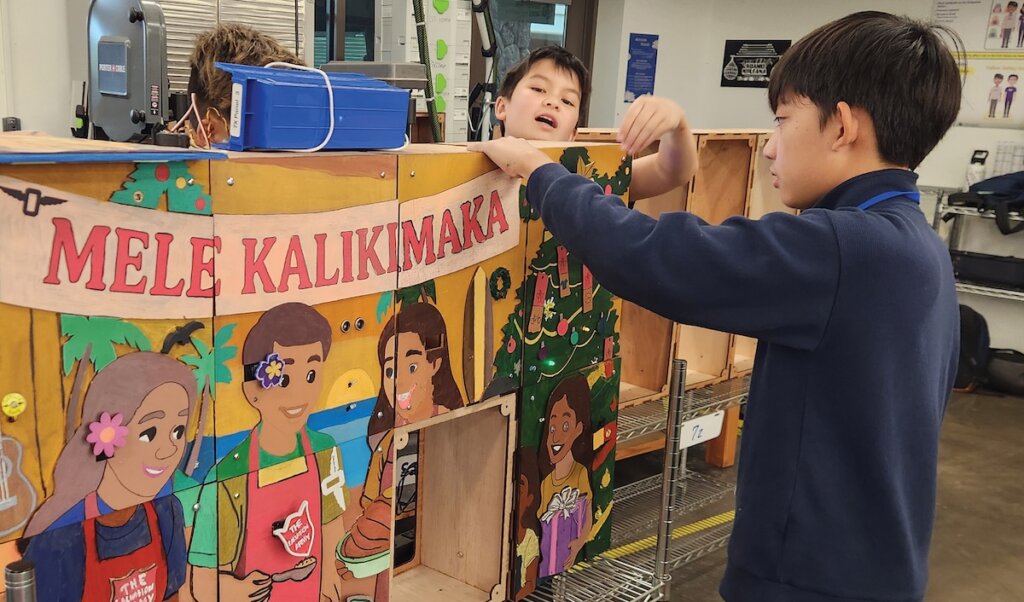

Students experiment with yet another tool, Hummingbird micro:bits. Using the simple robotics kits, they build motors, lights and sensors that bring their storyboards to life.
The finished projects are shared during a highly anticipated, hands-on exhibit in the Kosasa hallway. The winter 2026 display featured wriggling fish, light-up earrings and swinging arms that scooped up trash.
Seventh grader Makena Carney ’31 appreciated both the creativity and challenge of the course. “I was surprised by how many new things I learned, even after taking the class in previous grades,” she says. “I enjoyed working with others in a place where I could let my creativity be free and discover new ways to build and design.”
The current class is now at work highlighting the efforts of the Salvation Army, Hawai‘i Food Bank and local bee farm Hānai Hives in addressing food insecurity. “They’re focused on health needs, local harvest and why it’s so important to grow our own food here in Hawai‘i,” Ozaki says.
So the next time you walk through Kosasa, do not be surprised if you are greeted by a blinking bee or a mechanized hand offering a locally sourced plate lunch.
link