



When we talk about innovation in product design, we often picture futuristic tools, generative AI, or sleek minimalism. But real innovation doesn’t always happen in the spotlight. Sometimes, it happens in the margins, in the grey zones where the typical rules of design no longer apply, and where traditional assumptions begin to break down.
That’s exactly where neurodivergent users live.
These are the individuals whose brains process information differently, people with ADHD, autism, dyslexia, sensory sensitivities, or anxiety-related processing styles. Historically, they’ve been treated as “edge cases” users that design teams often circle back to, if there’s time. But in reality, neurodivergent users are showing us the cracks in our systems, the limits of our defaults, and the future of more human UX.
The Problem with “Normal” Design
Most digital products are built around the idea of a typical user: focused, patient, tech-literate, and emotionally neutral. In other words, not real.
For someone with ADHD, an app with cluttered menus and constant notifications can be overwhelming and anxiety-inducing. For an autistic user, unexpected animations or vague copy can feel disorienting and hostile. For someone who’s dyslexic, poor font choices and justified text can turn even simple tasks into barriers.
Designing only for neurotypical cognition leads to friction, not just for neurodivergent users, but for everyone. And yet, the industry keeps doing it, chasing aesthetics over accessibility and flash over function.
What we need is a shift: not toward designing for the average, but for the range of ways humans engage with the world.
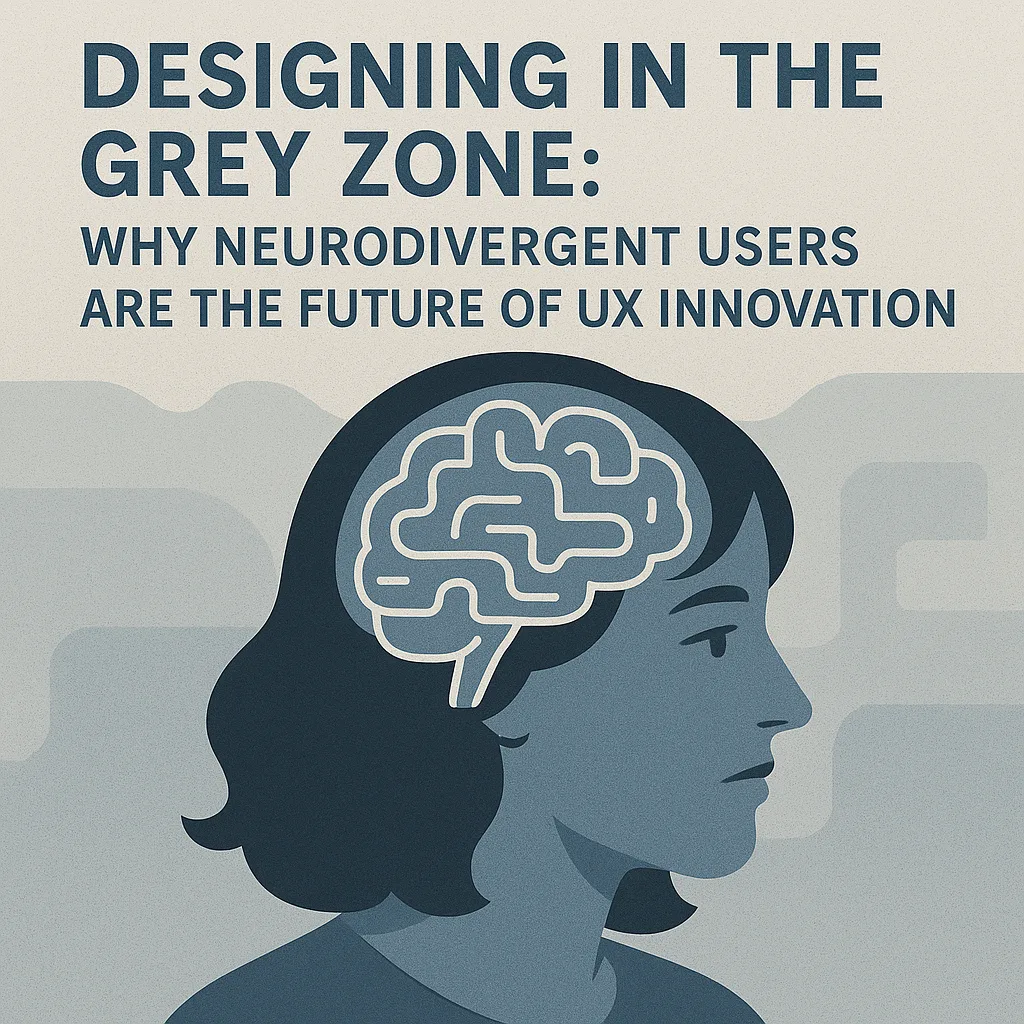

Why Neurodivergent Users Drive Better Design
1. They Reveal the Flaws Faster
Neurodivergent users often struggle with inconsistencies, hidden pathways, and overly abstract interfaces. If a product frustrates them, chances are it’s already confusing for others. Designing for them forces us to simplify, clarify, and prioritise.
2. They Push Us Toward Flexibility
Rigid interfaces serve no one. Neurodivergent needs, like text resizing, motion control, custom layouts, or focused modes encourage adaptive systems that benefit all users. What starts as a neuroinclusive feature often becomes a mainstream convenience.
3. They Reframe Success Metrics
What does “easy to use” actually mean? Neurodivergent testing challenges us to move beyond surface-level satisfaction scores. It urges us to consider how calm, focused, or confident a user feels, not just whether they clicked the right button.
Designing in the Grey Zone
Designing for neurodiversity isn’t about ticking accessibility checklists. It’s about embracing ambiguity, multiplicity, and flexibility. It means letting go of control and acknowledging that one path through your app or product may not fit every brain.
This is the grey zone, where not everything is clear, linear, or one-size-fits-all. It’s where your interface meets real human variability.
In this space, good UX becomes less about perfection and more about resilience. A neuroinclusive design doesn’t assume it’ll get everything right. It provides options, offers escape routes, and gives users the tools to customize their experience. It doesn’t force conformity. It meets people where they are.
The Future of UX Is Human Variability
The future of design isn’t just faster, smarter, or more beautiful. It’s more empathetic. More adaptable. More real.
And neurodivergent users are showing us how to get there.
By designing with and for them, we unlock insights into what truly matters: clarity, comfort, focus, autonomy, and trust. These aren’t edge features; they’re the heart of great experiences. And in an age where digital fatigue and cognitive overload affect everyone, neuroinclusive design isn’t just ethical; it’s essential.
Final Thought: Designing with Courage
It takes courage to challenge norms, to design in the grey zone where answers aren’t always neat. But this is where innovation lives, not in the places we’ve mastered, but in the ones we’re still learning to understand.
So the next time your team is drafting a wireframe, planning a feature, or running a user test, pause and ask, What would this feel like for someone who thinks differently?
Because chances are, if it works for them, it’ll work better for all of us.
About the Author
Folorunso Jeremiah is a creative and impact-driven Product Designer with over four years of experience crafting intuitive and scalable solutions across fintech, enterprise software, compliance, and emerging Web3 platforms. He brings a unique blend of user empathy, systems thinking, and strategic design leadership to help teams deliver products that are not only functional but also meaningful and transformative.
With a strong focus on clarity, usability, and innovation, Jeremiah has led design initiatives that streamline complex user journeys and align product vision with real-world impact. His approach bridges the gap between design and business outcomes, helping organisations navigate ambiguity and build with purpose.
Outside of his product design work, Jeremiah is a published author and thought leader, contributing to academic and industry knowledge on topics such as AI-powered creative workflows, secure-by-design principles, and AR/VR in instructional technologies. He is the founder of HelloCreatives, a platform that champions design education, visual storytelling, and mentorship for aspiring creatives across Africa and beyond. Through this initiative, he empowers the next generation of designers to grow with direction, confidence, and a deep sense of purpose.
Feature Image by Kohji Asakawa from Pixabay
link