


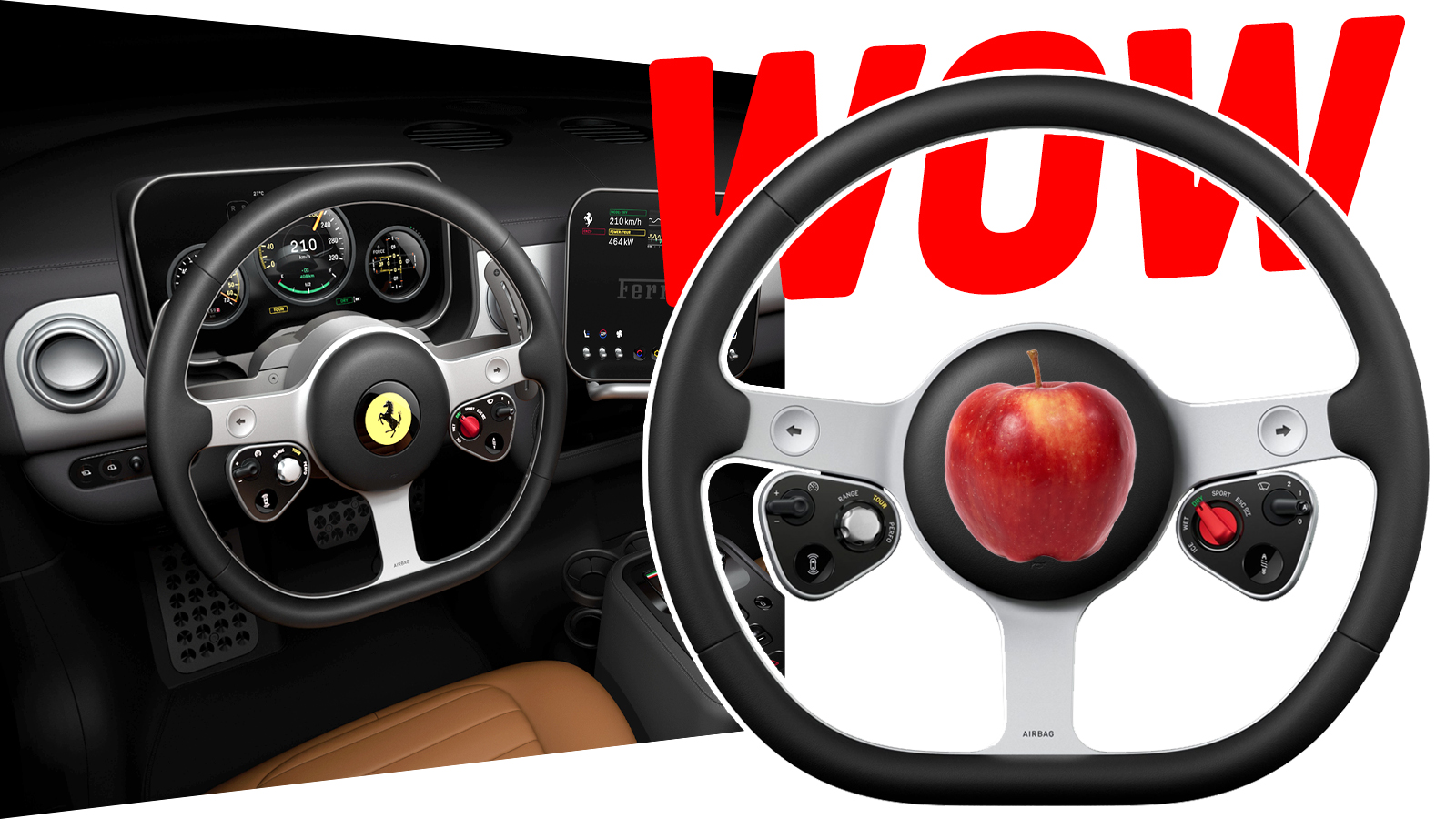
For as long as I have been driving cars for work, I have known one thing about Ferrari: It doesn’t really know how to make a cohesive interior. Whether that’s nonsensically located radio controls, no central infotainment screen, infuriating touch-capacitive controls, or buttons that get weirdly sticky after a few years, there’s never been a modern Ferrari that’s had a cabin that doesn’t bother me in some way.
Instead of trying its hand at the interior of its latest car, an all-electric four-seater called the Luce, Ferrari decided to enlist the help of Jony Ive, former head of design at Apple and credited as the designer of the iPhone, to do the job instead.



Going by images released of the cabin today, I’d say hiring Ive was probably the best thing Ferrari has done for itself in years. Because it looks spectacular.
I Simply Cannot Believe Ferrari Got It This Right


Wow. Just look at that driver’s cell. I had my doubts when Ive first signed onto this project with Ferrari, but honestly, I think he and his team absolutely knocked it out of the park here. There are so many things to talk about, but I think it’s worth starting at the most important part of any interior: The steering wheel.


In a world where thick rims and weird multi-spoke designs dominate the luxury and exotic field, the Luce’s steering wheel is an obvious outlier. It looks as if it was lifted straight off of a 308 GT4 from the 1980s, with three simple, flat metal spokes and a thin rim that’s mostly round. It’s simple and elegant, and most importantly, it has nothing but real buttons, toggle switches, and knobs for all of the controls.
Because Ferrari doesn’t believe in turn signals or wiper stalks, all of those controls are incorporated into the wheel, as they have been since the 458 Italia. The only two buttons embedded into the spokes are the turn signals, which are matched to the same metal color as the spokes to blend in. Every other button is bunched into two nodes below the 3 o’clock and 9 o’clock stalks, and while they’d look a bit out of place on a 308, they fit nicely here.

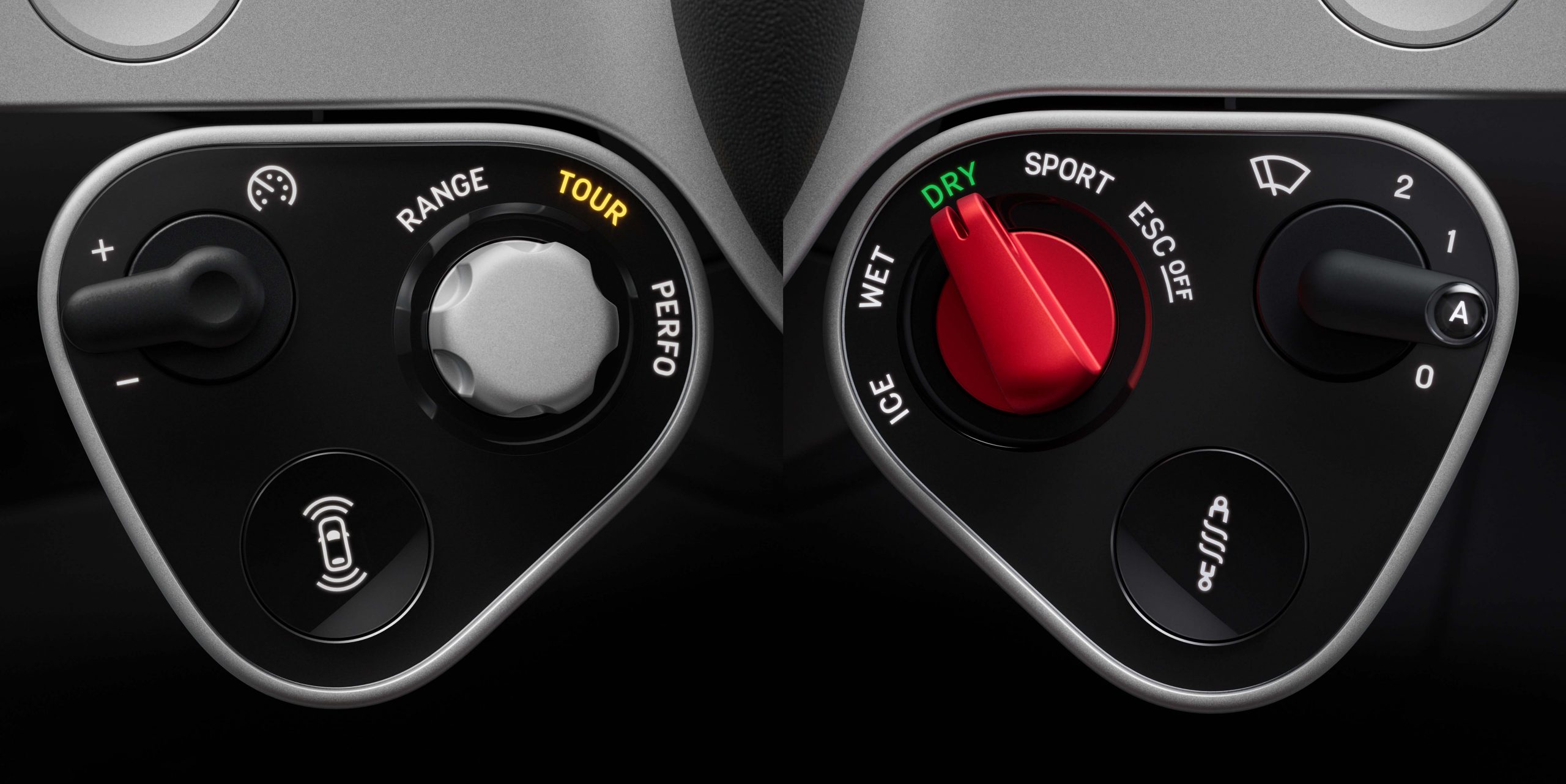
On the left module, you’ll find controls for things like the active safety systems and the cruise control. On the right node, there’s a toggle switch for the wiper blades, Ferrari’s famous Manettino switch for drive modes, and a button with a coil-over printed on it, presumably to enable or disable Ferrari’s well-known “bumpy road” mode, which softens up the shocks when pressed. Note how all of these controls are real, actual buttons, not the touch-capacitive nonsense Ferrari’s been running with on its steering wheels for the past few years.


Thankfully, it’s more of the same throughout the rest of the interior. The control panel, which houses the infotainment screen, is centrally located but mounted on a pivot system, which means it can be turned to face either the driver or the passenger (or sit dead in the center). Even better, you’ll see at the bottom that it’s loaded with real buttons and toggle switches for stuff like the climate control and seat temperature. That clock-looking thing on the top right? It’s a multigraph that can act as a clock, chronograph, compass, or launch control timer, and even has physical buttons of its own along the edges of the panel.


All of this makes sense if you know Ive’s opinion on buttons. He predicted the industry’s move back to physical buttons all the way back in 2022 in an interview with Australian outlet Drive:
“I do think there are fabulous affordances with interfaces like, for example, multi-touch [the technology allowing for pinching and zooming on phone screens],” Ive said.
“But we do remain physical beings. I think, potentially, the pendulum may swing a little to have interfaces and products that will take more time and are more engaged physically.”
When the panel’s moderator – journalist Kara Swisher – asked if Ive was referring to cars, the former Apple design boss responded, “for example”.
In a way, Ive simply had a hand in making his own predictions come true. But that’s not to say there aren’t screens. In addition to the one found on the control panel, there’s another in the rear for back seat climate controls, and a third embedded into the gauge cluster.


Though the cluster looks analog, it’s fully digital underneath. The three round cutouts give data to the driver like an analog cluster would, with the goal of not overwhelming the driver with info. From Ferrari:
The binnacle’s graphics are inspired by the clarity and elegance of historic instrument dials, particularly Veglia and Jaeger instruments from the 1950s and 60s. Drawing on decades of experience in horological design, the team sought to achieve a watch-like clarity, creating a modern, clean layout that highlights the legibility of the dials. Information is presented in a way that is immediately legible and intuitively understood.
This approach is rooted in the concept of reducing cognitive load for the driver. By referencing the simplicity of analogue watch dials, where time can be read at a glance, the designers aimed to make the car’s controls and displays equally intuitive. The graphics are purposefully minimal and clear, allowing drivers to glean essential information quickly and effortlessly while keeping their attention on the road.


The center console has been redesigned as well, and it looks just as slick. It includes the four window switches, the luggage compartment release, the lock switch, the hazard light button, the gear selector, and a little indent area specifically to hold the car’s keyfob. There are also two cupholders mounted just forward of the console itself. The tiny selector switch is made from Corning Fusion5 glass that had to be etched by laser, according to Ferrari:
To achieve the level of precision required by Ferrari, lasers were used to make tiny holes in the glass half the width of a human hair to deposit the ink for the graphics with the perfect level of uniformity. Fusion5 is designed to offer superior surface durability as well as better impact and scratch resistance than conventional glass and is used on the control panel, binnacle and on the surface of the central console.

Is it as cool as Ferrari’s retro-style gated shifter-shaped gear selector? No, I don’t think so. But it does still look pretty cool.
Let’s Talk About That Name
In addition to revealing the interior, Ferrari also revealed the final name for its first production electric car: Luce. It translates literally from Italian to “light.” Hearing that, you might think Ferrari went all-out on making sure its EV would be as lightweight as possible, breaking the trend in the electric performance car space of exceedingly heavy vehicles. But you’d be wrong.
According to Car and Driver, which attended an unveiling event for the car’s interior, the Luce will still come in at “under 5,100 pounds,” or two and a half tons. For some context, that’s a bit more than a BMW i4 and a tiny bit less than a Tesla Model X. It’s also more than two Miatas.


Even when comparing the Luce to other performance EVs, it’s on the heavy side. The Hyundai Ioniq 5 N is a few hundred pounds lighter, at 4,849 pounds. The Taycan Turbo GT, the most expensive, quickest version of Porsche’s four-seater EV, comes in at 4,915 pounds. It does have the Lucid Air Sapphire beat, though, with that car coming in at over 5,300 pounds.
In reality, “light” refers to luminescence, not lightness. That makes a bit of sense, considering the electric drivetrain and all. Thankfully, no numbers or letters are accompanying the name, at least for now, which I prefer. Alphanumerical car names are almost always boring—if you’re going to call a car a Testarossa, call it the Testarossa! Don’t slap the number 849 in front of it just to keep in line with corporate naming structure.
The Luce’s final design has yet to be revealed, but that should come in the Springtime along with all of the specs. With demand for ultra-high-end EVs nearly nonexistent, I’m really curious to see how it performs.
Top graphic image: Ferrari
link