Stuckeman hosts inaugural interdisciplinary design competition, names awardees
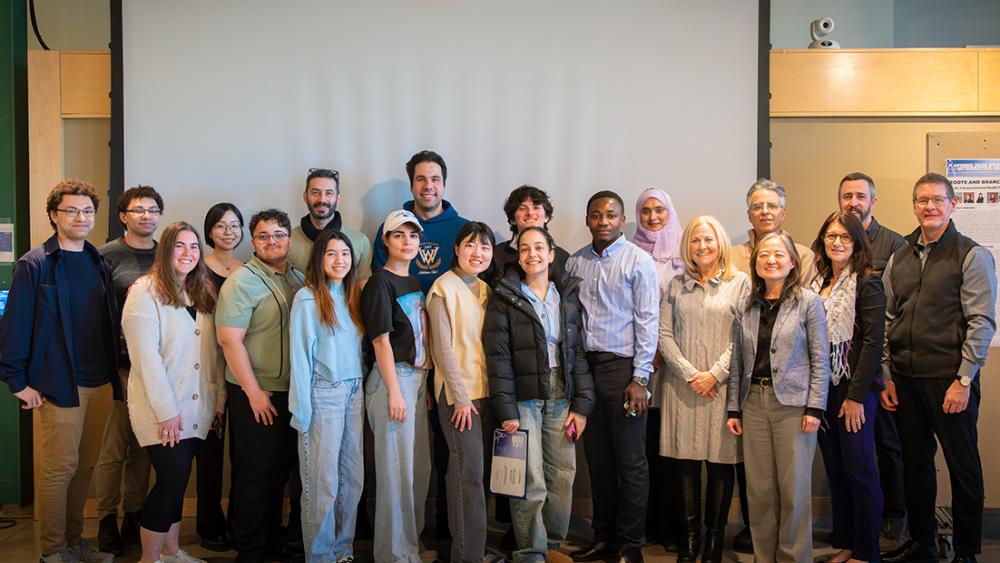
Competition winners
The team that was awarded the top prize of $4,000 included: John Akudugu, a nursing graduate student; Behnoud Alaghband, an architecture graduate student; Rojina Azadi, a graphic design graduate student; Mohammed Rezvan, an architecture graduate student focusing on landscape architecture; and Yuri Moros, an undergraduate architecture student.
They used Sidney Friedman Park in State College as a site to create their design because it was the most accessible and safest site out of their choices, according to Alaghband.
The team wanted to design a space appropriate for people of all ages in the surrounding community to promote healthy connections. To achieve this, the team created their space in “layers,” separating each generational setting.
During their presentation, the team explained how they categorized spaces into three main types: mono-generational, multigenerational and intergenerational. They created spaces enabling people to engage in both indoor and outdoor activities together or separate.
“We wanted to make a ‘layer’ in the building for each generational setting with the intergenerational one in the middle,” Moros said. “This allows for inhabitants of any generation to not feel pressured to interact and [they] can socialize at their own pace.”
A second team earned a $1,000 merit prize and included: Samiya Al-Hadhrami, a nursing graduate student; Yuni Chern, a graphic design graduate student; Nazanin Malakutian, a landscape architecture graduate student; and fifth-year architecture students, Jeremy Lynn and Khin Yadana Lwin.
The team’s project, titled “Roots and Branches at Sycamore Springs,” was based on understanding how people age, move and build relationships, according to Chern. The conceptual framing of the project comes from the metaphor of a living tree.
The site was strategically placed within a residential area near schools and public infrastructure with opportunities for government-supported programming.
“The design is structured around a Wellness Loop, which is an intuitive circulation system that connects eight distinct program zones,” Lwin said. “This special gradient allows users to choose their level of engagement while remaining part of a shared community.”
The projects were grounded in a significant amount of public health research and the expertise of advisors from different disciplines. Iulo said she was impressed with the student work and research.
“It was really incredible to see the diversity in the teams and approaches as well as the sites that were selected,” Iulo said. “It was professional caliber work all around.”
Whitaker commended the projects for their attention to the crises that many in today’s aging society are facing.
“The students became more aware of the impact of agism in our society as well as the need for age-friendly design practices and positive outcomes related to connections between people of all ages,” Whitaker said.
Both teams plan to refine their projects based on the jury’s feedback and will submit the updated projects to the International Intergenerational Community Design Competition.
link