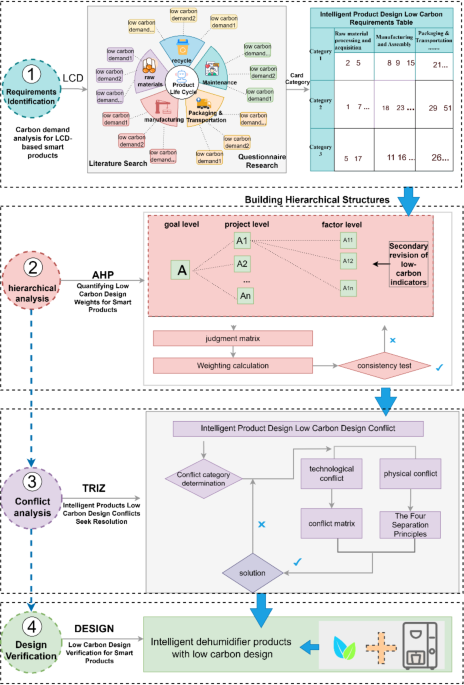
LCD-AHP-TRIZ methodology enhances low-carbon principles in smart product design
LCD-based low carbon design requirements identification results for smart products
In this study, the collected keywords were statistically analyzed for word frequency using the professional statistical analysis software SPSSAU and its word cloud function. After rigorous screening, keywords with a word frequency of less than three were eliminated, and 121 high-frequency keywords were ultimately identified to construct a pool of indicators for the low-carbon design requirements of smart products. On this basis, this study employed a questionnaire research method to present 121 keywords of low-carbon design needs for smart products on white paper to ensure legible handwriting and a logical layout for expert review. Experts were invited to evaluate the keywords independently and objectively based on their professional knowledge and practical experience in the field of smart product design and low carbon, fully respecting their subjective judgment and minimizing external interference. Through statistical analysis of the experts’ selection results, 56 keywords with a frequency of more than five words were identified, thus forming the initial draft of keywords for the life cycle of smart products.
Subsequently, 56 keywords were categorized using an open-card classification method. The experimental procedure is as follows:
Experiment Preparation: 56 keywords were numbered and printed on blank cards with uniform specifications.
Execution of the experiment: A sufficiently large table was prepared, and participants were informed that the 56 keywords represented the low-carbon needs of the smart products. They were instructed to divide words with similar meanings into groups, according to their perceptions. The number of groups was not restricted, and minimizing the number of groups was encouraged.
Grouping information collection: The number of groups formed by each participant and the number of keywords in each group were recorded, as shown in Fig. 3.

Categorization of low carbon demand cards for smart products.
Category identification was conducted based on the multiple low-carbon requirements within each category. Following the statistical analysis, five distinct categories of low-carbon requirements for smart products were established: energy efficiency, design, technology, environment, and cost.
Utilizing these five categories, five life-cycle stages, and 56 low-carbon demand indicators, a low-carbon smart product life-cycle demand table was constructed to form the initial indicator pool for this study. A 5 × 5 low carbon demand table was developed for this investigation. The model incorporates the product life cycle on the horizontal axis and five major categories of low-carbon requirements on the vertical axis, thereby effectively illustrating the low-carbon design requirements of smart products at different stages. The five categories are energy efficiency, design, environment, technology, and cost, as shown in Fig. 4.

Low-carbon design requirements identification for the whole life cycle of smart products.
In terms of energy efficiency, it mainly includes low-carbon needs such as using clean energy (1), improving equipment operation efficiency (21), low energy efficiency usage patterns (38), and low energy efficiency recycling and processing (34); in terms of design, it mainly includes designing for the use of recyclable and biodegradable materials (36), designing for the digital simulation of products (36), designing for separable packaging of products (13), and designing for multi-functional use (50), component modularization design (29) and other low-carbon needs; in the environmental aspect, it mainly includes biodegradable materials (10), environmentally friendly production processes to reduce pollutant emissions (22), to strengthen the management of e-waste (39), to achieve product recycling (40) and other low-carbon needs; in the technical aspect, it mainly includes the tracing of the source of the material (43), intelligent low-carbon production processes (49), low-carbon packaging based on intelligent technology (41), intelligent safety and protection (41), and low-carbon packaging based on intelligent technology (42). packaging (41), intelligent safety and protection technology (45), intelligent product recycling monitoring (23), and other low carbon requirements. Cost mainly includes reducing the cost of material recycling (20), reducing the cost of manufacturing (11), reducing the cost of technological inputs (8), reducing the cost of the user (4), and other low-carbon needs.
AHP-based evaluation system for low-carbon design of smart products and weighting analysis of low-carbon indicators
Determination of AHP-based evaluation system for low-carbon design of smart products
The indicators of low-carbon design of intelligent products are multilevel and multifactorial problems. In order to systematically analyze and determine these indicators, through card taxonomy and secondary modification, we determined a three-level evaluation system for low-carbon design of smart products, and the evaluation system item level includes energy efficiency A1, design A2, environment A3, technology A4, and cost A5, energy efficiency level A1 focuses on applying clean energy A11, improving the efficiency of equipment operation A12, optimizing the production process A13, energy recycling A14, and adjusting of fuel ratios A15 five indicators; design layer A2 focuses on five indicators: digital simulation design of products A21, lightweight design of components A22, standardized design of components A23, modular design of components A24, and integrated design of products A25; environmental layer A3 focuses on the five indicators of carbon dioxide recovery A31, clean production A32, noise-reducing structures and material applications A33, strengthening e-waste management A34, and use of biodegradable recycled materials A35; and the technology layer A4 focuses on the five indicators of intelligent security protection technology A41, intelligent repair and diagnostic technology A42, and intelligent operation and interaction technologiesA43, carbon capture, carbon capture, separation and storage technologies A44, and smart traceability and recycling guide A45 five indicators; and the cost layer A5 involves reduce material recycling costs A51, reducing manufacturing costs A52, reducing user costs A53, reducing technological input costs A54, and reduce recycling costs A55 five indicators, as shown in Fig. 5.

Low-carbon evaluation system for smart products.
AHP-based weighting analysis of low-carbon design indicators for smart products
Following the clarification of the low-carbon indicator system, the geometric mean of the 32 scale values was calculated to aggregate the data through expert evaluation and obtain a new aggregated judgment matrix, A’. Using the five indicators in the Level 1 guideline layer as an example, weight values for each indicator were derived according to the Analytic Hierarchy Process (AHP) calculation procedures (see Table 2).
The above table yields W = (0.2025, 0.1630, 0.2668, 0.2244, 0.1432), which allows the maximum eigenvalue\(\:\lambda\:max\)= 5.0157 to be found, and the consistency index test can be performed. By calculating\(\:{c}_{1}=\frac{\lambda\:{max}-n}{n-1}=\) 0.0039,\(\:\text{CR}=\frac{\text{C}1}{\text{R}1}=0.0035\). The consistency ratios of the groups for the second-level criterion, presented in Table 3, show that all CR values remained below 0.1, which is regarded as a verification of the transferability of the aggregated judgment matrix. Therefore, the consistency is acceptable. Consequently, the results of the assessment of the importance of each indicator are considered reasonable.
Ultimately, by multiplying the item-by-item multiplication of the weight values of the first-level item level and the factor level, the combined weight value of each second-level requirement in the overall target requirement architecture is calculated and ranked in order of magnitude. The detailed results are presented in Table 4.
From the combined weights of the indicators in Table 4, it is evident that the Level 1 guideline tier emphasizes the environmental and energy efficiency aspects more than the other tiers. Examining the Level 2 indicator layer, the top 12 indicators with higher weights were selected as key requirements and categorized into three tiers to identify essential low-carbon design indicators for smart products.
As shown in Table 5, among the low-carbon design indicators for smart products, the notable Level 1 indicators are the use of biodegradable recycled materials A35, use of clean energy A11, carbon dioxide recovery A31, intelligent operation and interaction technology A43. The notable Level 2 indicators are energy recycling A14, intelligent security protection technology A41, trengthening e-waste management A34 and reduce recycling costs A55. Level 3 significant indicators are carbon capture, separation, and storage technologies A44, clean production A32, modular design of components A24, smart traceability, and recycling Guide A 45. These tertiary indicators are important for low-carbon design of smart products.
Conflict problem solving results for TRIZ-based low carbon design of smart products
Through a comparative analysis of the key issues presented in Table 5, TRIZ conflict-resolution theory was implemented for innovative design. Two categories of physical conflict and three categories of technical conflict were transformed through conflict analysis and table examination, as presented in Table 6.
For each of the above five conflict issues, one technical conflict and one physical conflict were selected for specific analysis.
-
(1)
Utilization of biodegradable and recyclable materials can enhance environmental compatibility and contribute to low-carbon objectives. However, such materials often exhibit inferior mechanical strength compared with traditional materials, which presents challenges in meeting the requisite stability and reliability of smart products. Consequently, the structural integrity of smart products and mitigation of environmentally detrimental factors constitute a pair of technical conflicts. Based on technical conflict analysis, key principles such as 35, 40, 27, and 39 were identified to resolve the conflict by examining the 39 × 39 conflict matrix.
-
(2)
The implementation of clean energy technologies aims to reduce environmental management costs and energy-related risk. However, the associated high technology and equipment costs present a significant contrast, particularly in the input, production, and utilization phases, and constitute a physical contradiction to the low costs of environmental management. This physical contradiction can be addressed by applying the time separation principle, which is one of four separation principles. By examining the 39 × 39 matrix of contradictions, several inventive principles were identified to address this issue, including 9, 10, 11, and 15 principles.
Practical validation results
The increasing demand for improved air quality and enhanced living comfort has led dehumidifiers to become essential appliances in numerous households. Dehumidifiers effectively reduce the proliferation of bacteria and molds in high-humidity environments, thereby protecting human health and preserving furniture and electrical equipment, thereby extending operational lifespans. However, traditional dehumidifier products exhibit limitations, such as substantial power usage and poor choice of materials throughout their life cycle. With the continuous advancement of intelligent technology, dehumidifier products are undergoing upgrades, and have become representative examples of the transformation from traditional to intelligent products. Consequently, the aim of this design is to create an intelligent dehumidifier that complies with low-carbon design principles, aiming to achieve both environmental sustainability and an enhanced user experience.
Low carbon demand identification for LCD-based smart dehumidifier
To enhance the low-carbon performance of dehumidifiers more effectively, it is imperative to conduct a comprehensive analysis of their equipment lifecycle. Based on the low-carbon design demand identification table for the product’s full life cycle presented in Table 1 and in conjunction with the specific characteristics of the dehumidifier products, the low-carbon requirements for intelligent dehumidifiers are identified.
-
(1)
Raw material stage.
Refrigerants utilized in dehumidifier products, such as chlorofluorocarbons (CFCs), have a considerable adverse impact on the environment as they possess the capacity to deplete ozone shields and thus exacerbate global warming trends, corresponding to the low-carbon requirements of No. 32 (replacement of low-toxicity materials) under the environmental category.
Dehumidifier products employ non-renewable or difficult-to-recycle materials such as plastics and metal alloys containing hazardous substances, which consume substantial amounts of energy during the production process and are extremely challenging to degrade or recycle after use, thereby imposing long-term environmental pressure. This corresponds to the low-carbon needs of the Technology and Environment Categories No. 27 (use of environmentally friendly materials) and No. 36 (design of recyclable and biodegradable materials).
-
(2)
Processing and manufacturing.
Compression refrigeration technology has been widely implemented for dehumidifiers. However, its substantial energy usage and poor energy efficiency characteristics contradict the core concepts of contemporary energy conservation and emission reduction. This corresponds to the life-cycle stage of energy efficiency under Category No. 21 (improving the operational efficiency of equipment) for low-carbon needs.
For dehumidifiers, such as industrial and household products, the susceptibility of their key components to failure necessitates their frequent replacement. However, limited product disassembly options impede the component replacement process, resulting in increased product utilization costs. This corresponds to the low-carbon needs of design category 5 (design for the easy replacement of damaged components) and low-carbon needs of cost category 8 (reduction in technical input costs).
-
(3)
Utilization of the maintenance phase: Traditional dehumidifier products are undergoing intelligent transformation and upgrading, necessitating the implementation of intelligent technologies to achieve advanced control of dehumidifiers, remote monitoring, energy-efficiency optimization, and low-carbon environmental protection. This corresponds to technology categories 12 (intelligent operation and interaction technology), 45 (intelligent safety and protection technology), and 19 (intelligent maintenance and diagnostic technology) for low carbon demand.
-
(4)
Packaging and transportation stage: The emergence of new intelligent technologies enables intelligent packaging to achieve comprehensive product tracking, optimize transport routes, reduce logistics costs, and facilitate packaging reuse. This corresponds to technology category 41 (low-carbon packaging based on intelligent technology) and the other low-carbon requirements.
-
(5)
Recycling treatment stage: The primary function of the dehumidifiers is to extract moisture from the air; however, the collected water, as a resource, currently does not achieve closed-loop utilization of water resources. This corresponds to the environmental category under the low-carbon requirements of recycling treatment stages 1 (use of clean energy), 3 (carbon dioxide recycling application), and 7 (waste materials into energy).
The low-carbon demand for smart dehumidifiers is derived from the aforementioned analysis, as shown in Fig. 6.

Low carbon demand identification for smart dehumidifiers.
AHP-based low-carbon design index analysis of dehumidifiers
The low-carbon design of an intelligent pot plant dehumidifier was systematically examined. Initially, the low-carbon requirements of the dehumidifier products (1, 3, 5, 7, 11, 12, 19, 21, 27, 32, 33, 36, 41, 45) were considered in relation to the corresponding low-carbon indicators (A11, A12, A14, A24, A31, A35, A41, A42, A43, and A54), as shown in Fig. 2. Subsequently, Table 4 was used to establish the weighting hierarchy of indicators. This analysis culminated in the identification of seven critical indicators for intelligent dehumidifiers: clean energy utilization (A11), energy recovery and recycling (A14), component modular design (A24), biodegradable material implementation (A35), CO₂ recycling and reuse (A31), intelligent safety mechanisms (A41), and the incorporation of intelligent operational and interactive technologies (A43). The results are summarized in Table 7.
TRIZ-based low-carbon innovation design of intelligent potting dehumidifier
In the low-carbon design process of the intelligent pot plant dehumidifier, for the weight analysis of the low-carbon design indices of intelligent products throughout the entire life cycle, in conjunction with the core elements of the low-carbon design of intelligent products, utilizing the contradiction matrix table in TRIZ theory, we identified inventive principles such as No. 40 (application of composite materials), No. 34 (principle of abandonment and restoration), No. 22 (turning harm into benefit), No. 25 (self-service), No. 1 (division principle), and No. 17 (dimensional change), as shown in Table 8.
In this study, based on the TRIZ theoretical solutions presented in Table 8, a practical exploration of low-carbon design concepts was conducted for a smart-potting dehumidifier. The design scheme is illustrated in Fig. 7. In the material selection process, the dehumidifier incorporates an ecological innovation strategy by utilizing naturally degradable and environmentally friendly materials to ensure that the environmental effects of the product are minimized at the disposal stage, thereby significantly reducing the environmental burden. Furthermore, the design innovatively integrates the photosynthesis mechanism of potted plants to establish a highly efficient carbon cycle system that facilitates effective recycling and reuse of waste carbon dioxide. Through the integration of intelligent sensing and regulation technology, the smart potted plant dehumidifier achieves automated regulation and optimization of the dehumidification function, thereby significantly enhancing energy utilization efficiency. Regarding the product structure design, a modularized layout concept is employed, which enhances the expandability and maintainability of a product and effectively extends its service life. These design innovation strategies collectively constitute the low-carbon design scheme of a smart potted plant dehumidifier, aiming to achieve the dual objectives of environmental sustainability and user experience optimization.

(A) Product design plan; (B) Smart interactive interface; (C) Principle of interlligent potting dehumidifier; (D) Modular design function. All images were designed and drawn by the author in collaboration with Min Zhang using 3D Modeling Software Rhino 7.0 (Version 7.0, URL: https://www.rhino3d.com)).
Low carbon design evaluation of intelligent potting dehumidifier
In order to verify the feasibility of the low-carbon design scheme of the intelligent potting dehumidifier, according to the hierarchical analysis weights51, the evaluation factor set\(\:U=\left\{U1,U2,U3,U4,\left.U5,U6,U7\right\}\right.\) is established by selecting the indicators A11, A14, A24, A31, A35, A41, and A43. The rubric set is a collection of indicator evaluation levels, and the rubric set\(\:V=\left\{V1,V2,V3,V4,\left.V5\right\}\right.\) is established to represent good, better, average, poor, and very poor, respectively, and is also assigned the value of V= [5, 4, 3, 2, 1]. Weight vector W was derived from the AHP-normalized weights as W= {0.1705, 0.1269, 0.0914, 0.1482, 0.1985, 0.1235, 0.1410}. To ensure the objectivity and scientificity of the survey and research, this study adopted an expert questionnaire for the evaluation. The degree of affiliation of the indicators refers to the ratio of the number of people whose evaluation result was a comment to the total number of people who conducted the evaluation. The key to the fuzzy comprehensive evaluation method lies in determining the degree of affiliation for each indicator. Fifty survey respondents were invited to evaluate the indicators and to calculate an affiliation matrix. A total of 50 questionnaires were distributed and 47 valid questionnaires were recovered, which was 94% effective. The affiliation matrices are listed in Table 9.
-
(1)
The score for each indicator is calculated as follows:
Q1 = R1*V= *\(\:\left[0.26\:0.42\:0.16\:0.08\:0.02\right]\left[5\:4\:3\:2\:1\right]\)T=3.64.
Q2 = R2*V= *\(\:\left[0.28\:0.50\:0.08\:0.04\:0.04\right]\left[5\:4\:3\:2\:1\right]\)T=3.76.
Q3 = R3*V= *\(\:\left[0.30\:0.40\:0.12\:0.08\:0.04\right]\left[5\:4\:3\:2\:1\right]\)T=3.66.
Q4 = R4*V= *\(\:\left[0.28\:0.48\:0.14\:0.06\:0.00\right]\left[5\:4\:3\:2\:1\right]\)T=3.80.
Q5 = R5*V= *\(\:\left[0.32\:0.50\:0.08\:0.04\:0.00\right]\left[5\:4\:3\:2\:1\right]\)T=3.92.
Q6 = R6*V= *\(\:\left[0.30\:0.40\:0.16\:0.06\:0.02\right]\left[5\:4\:3\:2\:1\right]\)T=3.72.
Q7 = R7*V= *\(\:\left[0.30\:0.48\:0.10\:0.04\:0.02\right]\left[5\:4\:3\:2\:1\right]\)T=3.82.
-
(2)
The total affiliation vector and scores were calculated.
R=\(\:\left[\begin{array}{c}0.26\:0.42\:0.16\:0.08\:0.02\:\\\:0.28\:0.50\:0.08\:0.04\:0.04\\\:0.30\:0.40\:0.12\:0.08\:0.04\:\\\:0.28\:0.48\:0.14\:0.06\:0.00\:\\\:0.32\:0.50\:0.08\:0.04\:0.00\\\:0.30\:0.40\:0.16\:0.06\:0.02\:\\\:0.30\:0.48\:0.10\:0.04\:0.02\:\end{array}\right]\)
$$\:\text{B}\hspace{0.17em}=\hspace{0.17em}\text{W}\text{*}\text{R}=\left[0.1705\:0.1269\:0.0914\:0.1482\:0.1985\:0.1235\:0.1410\right]\text{*}\left[\begin{array}{c}0.26\:0.42\:0.16\:0.08\:0.02\:\\\:0.28\:0.50\:0.08\:0.04\:0.04\\\:0.30\:0.40\:0.12\:0.08\:0.04\:\\\:0.28\:0.48\:0.14\:0.06\:0.00\:\\\:0.32\:0.50\:0.08\:0.04\:0.00\\\:0.30\:0.40\:0.16\:0.06\:0.02\:\\\:0.30\:0.48\:0.10\:0.04\:0.02\:\end{array}\right]=\left[0.29\:0.46\:0.12\:0.06\:0.02\right]$$
Q = B*V= \(\:\left[0.29\:0.46\:0.12\:0.06\:0.02\right]\text{*}\left[5\:4\:3\:2\:1\right]\)T=3.77.
The calculation shows that the evaluation results of each index of the low-carbon design scheme of the smart potting dehumidifier are greater than 3.77 points, and the low-carbon design of the smart potting dehumidifier verifies the universal adaptation of the integrated methodology.
link